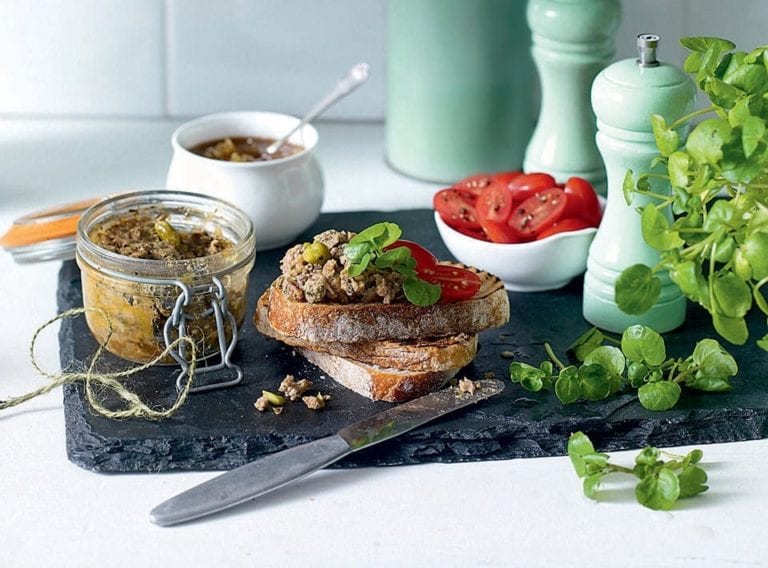

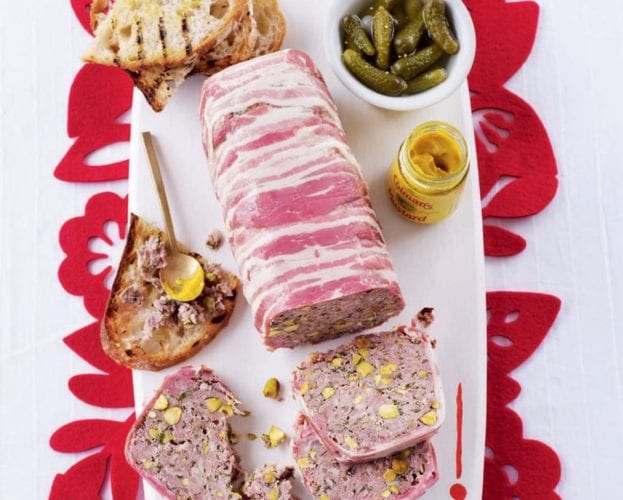
This rich pork pâté recipe has a wonderful meaty texture with a fairly coarse consistency, enhanced by the addition of nuts. It uses several different cuts of pork: pork belly, pork liver and bacon rashers. It’s a cinch to make and cooks in a Kilner jar, which looks good and is easy to serve. All this needs alongside, for a fantastic lunch or starter, are a few hunks of good bread or toast, a perky chutney, some cornichons and ripe tomatoes, and a bunch of watercress.

Ingredients
- 100g pig’s liver
- 50g butter
- 1 large onion, finely chopped
- 2 garlic cloves, crushed
- 4 smoked bacon rashers
- 4 tbsp Madeira or port
- 8 fresh sage leaves, finely chopped
- Large handful of fresh parsley, finely chopped
- 1 tsp cayenne pepper
- 25g fresh breadcrumbs
- ½ tsp ground white pepper
- 300g skinless pork belly, roughly chopped
- 25g unsalted pistachio kernels
- 4 bay leaves
Specialist kit
- 4 x 200ml sterilised Kilner jars
Method
- Preheat the oven to 180°C/fan160°C/gas 4. Run the liver under cold water, then trim, removing any tough membrane. Chop roughly. Heat half the butter in a pan and gently cook the onion and garlic for about 8 minutes until starting to soften. Transfer to a bowl. Heat the remaining butter and fry the liver and bacon for 5-6 minutes until golden. Set aside to cool.
- Increase the heat and deglaze the pan: add the Madeira and bubble, stirring, until the pan residue is released. Tip into the bowl with the onion. Add the sage, parsley, cayenne, breadcrumbs, white pepper and a good pinch of salt. Mix well.
- In a food processor, pulse the pork belly with the cooled liver and bacon until finely chopped, giving a textured but not too coarse pâté. Transfer to the mixing bowl and mix with the other ingredients. Fold through the pistachio kernels.
- You can at this stage thoroughly cook a teaspoon of the mixture in a frying pan in order to taste it and check the seasoning, if you like. Divide the mixture evenly among 4 x 200ml sterilised Kilner jars (see our video on sterilising jars below), gently pressing down and smoothing over the top. Lay a bay leaf on top of each and clip the Kilner jars closed.
- Put the Kilner jars in a deep roasting tin and pour in boiling water to come halfway up the jars’ sides. Cook in the oven for about 1¼ hours until the pâté begins to shrink away from the sides of the jars. Remove from the roasting tin and leave to cool. Once cold, you can refrigerate the pâté for up to 1 week. Maturing it for a few days allows the flavours to mingle and develop. Remove the pâté from the fridge 15 minutes before serving, to allow it to reach room temperature.
FAQs
There are plenty of similarities between these two. Both terms refer to a dish of minced ingredients, cooked in a vessel at a low temperature. They’re usually based on meat – often liver – but can be made of fish or vegetables. Pâté and terrine are not the same thing, though. The word ‘pâté’ comes from the French word for ‘paste’. ‘Terrine’ refers to the loaf-shaped earthenware dish in which the mixture is cooked. Terrine is usually coarser than pâté, and often wrapped in bacon. It’s pressed after cooking, then turned out of the dish and cut into slices to serve, whereas pâte is usually served from its dish and spread on toast.
Nutrition
- 346kcals Calories
- 17.8g (7.1g saturated) Fat
- 18.8g Protein
- 26.7g (2.5g sugar) Carbs
- 1.3g Salt


Leave a comment, question or tip